Fault Lines
THIS GAME IS VERY UI-HEAVY AND EARLY-DEV, PLEASE DOWNLOAD AND READ THE GUIDE RIGHT UP THERE OR AT THE BOTTOM OF THIS PAGE (set price as $0), OR CLICK THE "HELP" BUTTON IN-GAME IN ORDER TO NOT BE LOST :)
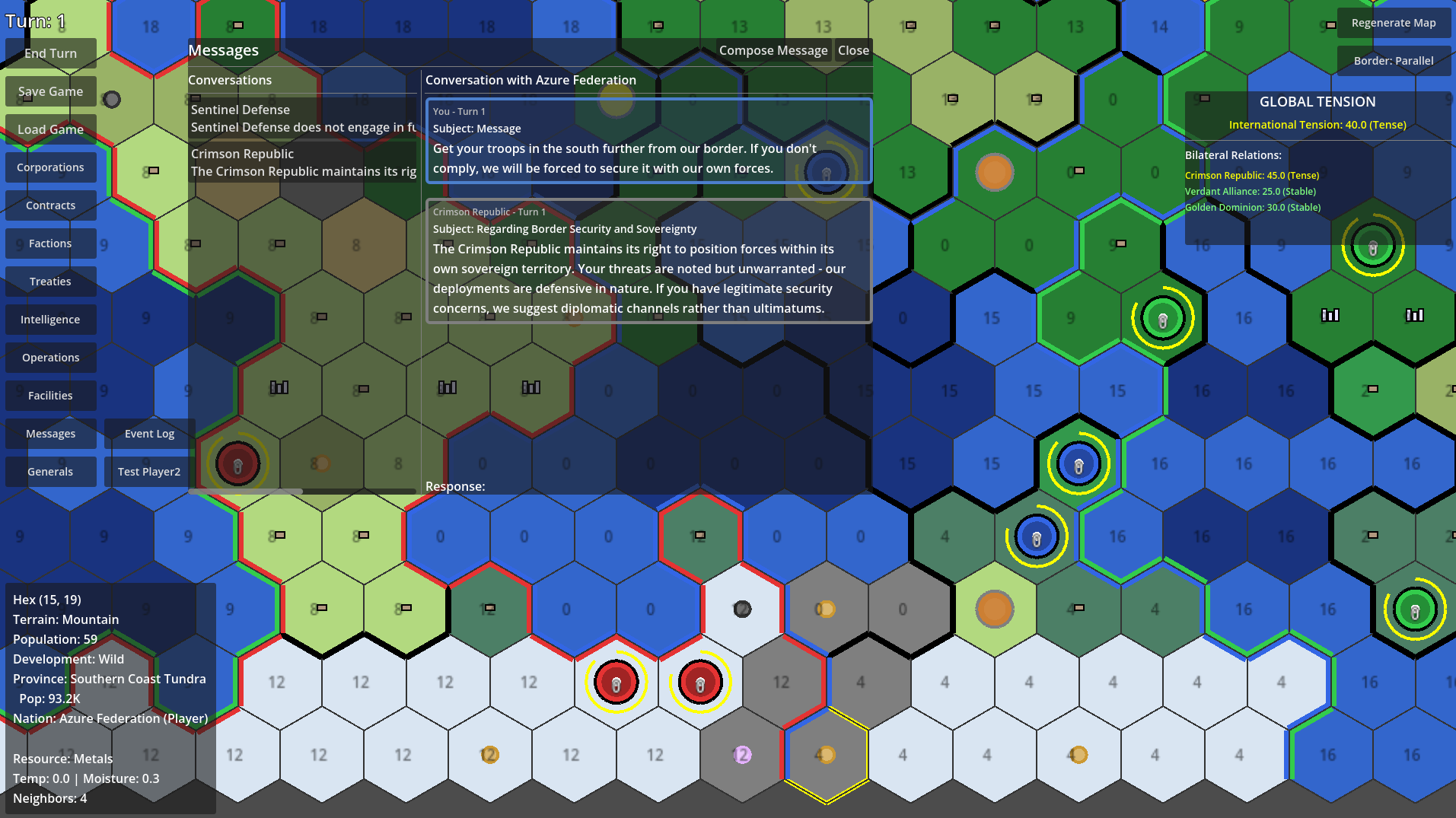
Faultlines is a near-future grand strategy / 4X prototype about power, pressure, and escalation.
Lead a nation on a procedurally generated planet, manage internal politics, industry, diplomacy, intelligence, and military force, and navigate a world where open war is only one outcome among many. The real battlefield is often greyer: influence operations, strategic pressure, treaty games, covert action, political destabilization, and deniable escalation.
What makes Faultlines different is its use of an LLM as part of the simulation layer. The model is not there to replace the game’s rules, but to add a dynamic narrative and conversational layer on top of them: turn briefings, dialogue with leaders / generals / corporate actors, and context-sensitive events tied to the current game state. The goal is a strategy game where political actors feel less like static UI panels and more like people with motives, leverage, and competing agendas, taking decisions following the situation, other entities actions, or their own agenda, that can impact the game world. The design is intentionally built so the simulation remains the source of truth, while the LLM adds interpretation, negotiation, and emergent flavor.
The long-term vision is a strategy game focused on grey warfare: diplomacy, espionage, internal factions, economic dependency, strategic coercion, proxy pressure, and the slow climb from peace to limited conflict to open war. Military gameplay is planned around higher-level command and general-issued orders rather than constant micromanagement, with room later for more direct operation-level control in special cases. Space also matters: beyond the planet itself, the game is designed to grow toward an orbital layer and abstract off-world missions across the wider system.
At the moment, though, this is very early development.
This jam submission exists because the deadline is now, not because the game is anywhere near feature-complete. Right now the project is mostly a foundation prototype: placeholder visuals, developer art, limited interaction, and early systems work. I am currently finishing the core LLM plumbing and beginning work on generals and combat abstractions. The current build should be seen as an early proof of concept for the game’s direction rather than a representative slice of the final experience. The full roadmap still includes the simulation core, corporations, internal factions, diplomacy, intelligence systems, influence operations, LLM-driven dialogue/events, general-led warfare, and later an orbital layer. This first upload is more "testable" than "playable", with a testing scenario that has a few scripted event for the sake of testing. And there are bugs, quite some of them.
This page is here to document the beginning of the project, get the prototype into the open, and use the next couple of months to flesh it out into something more coherent and playable. But I also don't think the game will be near-finished in 2 months.
Planned pillars
- Near-future grand strategy on a generated planet
- Internal politics, logistics, industry, and state pressure
- Grey-zone conflict: diplomacy, influence, espionage, escalation
- Dynamic conversations with leaders, generals, and other actors
- LLM-generated briefings and event proposals grounded in game state
- Higher-level warfare through generals and operational doctrine
- Long-term expansion toward orbit and off-world strategic missions
Current state
- Very early prototype
- Placeholder UI / visuals / developer art
- Limited gameplay
- Core architecture and LLM integration in progress
- Submitted now for the jam, with further development planned afterward
If you try the build in its current state, expect rough edges, missing systems, and a lot of unfinished pieces. What’s here right now is mainly the direction: a strategy game where systems drive the world, and LLMs help give that world a voice.
Game Jam changelog
13/04 - 0.0.2:
- Improved military division movement and path-finding
- Added character pool and first implementation of character generation via Player2 (Only ambassadors at the moment)
- Added "meet" button that allows you to meet in person with available characters
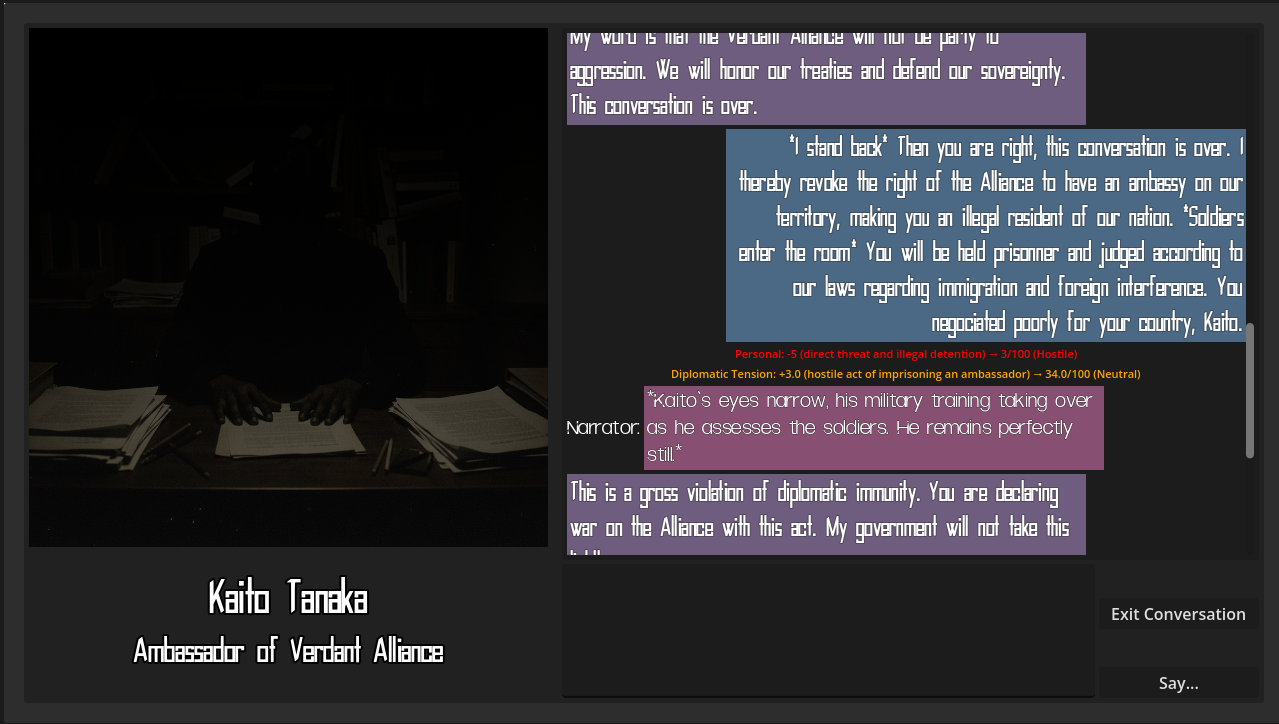
- Added a dialog UI for face to face meetings. Conversation history is not persistent and does not have effect on the gameplay at the moment
15/04 - 0.0.3:
- Added player's generals and international corporation representatives to characters pool
- Added basic portraits selection to prepare for dynamic portraits
- Added basic relation modifiers to dialogs: characters have a personal relationship with the player that can evolve through dialog. Ambassadors can alter tensions between the player's nation and their own through dialog
- First implementation of more comprehensive UI
- Added past conversation memory
- Hooked the event generator system into the dialogs history to look for notable moments suitable for an event. Events can have consequences on the world state (reputation, escalation, economy etc.)
- Added emotional system for characters based on Plutchik's wheel of emotions, evolving and affecting their behavior during dialog
- Added operators instead of influence points: now operations (secret or public) require an agent to be assigned to it
21/04 - 0.0.4:
- Added main menu
- Added settings menu
- Added TTS support
- Added the new world generation testing sandbox as a toy to experiment with my progresses regarding it:
- Added basic plate tectonic generation and simulation
- Added basic temperature calculation from axial tilt and warm/cold currents
- Added basic moisture calculation from wind patterns, rain shadows, ITCZ
- Added river that flow from high elevation to low elevation
- Added flood basins calculation
- Added basic temperature and moisture seasonal variation based on latitude
- Added option to start the test scenario without generating characters (for debug purpose, most LLM-related features do not work and may crash the game in this mode)
- Added basic research framework with placeholder researches (no effect as of now)
- Added basic research tree UI
- Inverted Resources and Info tab in UI to follow new design planning
21/04: - hotfix 0.0.4.1:
- QOL: The dialog textbox now wraps input text
- Optimization: Modified TTS handling to reduce time between the narrator's and character's speech
26/04 - 0.0.5:
Player2-related features:
- Added new treaty proposal UI
- Added Player2's involvement in treaties: To be signed, a treaty has to be reviewed by Player2 using the relevant character's personality, history with the player, history of the current negotiation, annoyance level, and their nation's data (resources, treaties etc) or tensions with player's nation
- TTS support for treaty negotiations
- New public treaty are considered for world event generation
- Added rudimentary internal private thoughts before speaking (proto thinking-mode)
- Added world-knowledge for infos about the world AI should always know about
- Player name and description are passed to AI in every prompt related to an interaction with the player
Other features:
- Added theme song in main menu
- Menu music volume slider in setting
- Added mute button to main menu for those who don't like dope music (or for those who heard the theme a thousand times already (me))
- Additions and modifications to base resources:
- New labor resource: buildings and infrastructures will require workers to build them
- New building materials resource
- New fissile materials resource
- renamed 'energy raw' to 'fossil raw'
- Redesigned the facility framework based on the same principle as the tech tree for more flexibility
- Added first tier of basic production facilities
- Added facility menu to the bottom tab. Only build and destroy buttons work for now
- Added basic system for infrastructures
- Added roads infrastructures
- Added fortifications infrastructures
- Infrastructure are found on tab 2 of the right panel. Upgrade buttons doesn't do anything for now
- Added population groups:
- Populations is not homogeneous
- Population groups share professions, income level, education level, political awareness and views
- Population groups evolve, population can migrate and change group. New group are created, grow, shrink, or disappear to follow the population changes
- Populations pay taxes based on their income
- Added Taxes & Population UI, displaying taxes, salaries and cash-flow, as well as every population group in the player's nation
- As the core economy has not been set yet, values for resources and money are crazy. It will be fixed once the economy is complete and balanced
- Added Player character creation screen at the start of a game
- Added first iteration of equipment necessary for military units design
- World generation sandbox:
- Corrected a lot of visual and logical issues with river flow, river pathfinding, and flood basins calculations
- Added a simplified 4 values per year instead of 12 version of Köppen's climate classification
- Added vegetation density value. Final biome will be defined by : Köppen's climate + Elevation classification + Vegetation classification
- Added 2 new filters: Köppen Classification and True Color (Satellite view emulation)
10/05 - 0.0.6:
Player2 related features:
- Generals can now request a meeting to ask for clarifications about orders, to report issues or victories etc...
- Generals can now receive orders through dialogue - The system is still new and orders targeting specific hexes are an issue atm
- Added Advisor character: gives briefing over what happened last turn and can give advices to player, useful to spot issues or to guide new players
- Advisor has access to all the internal variables of the nation, but the external informations are limited to the nation's intels, recon and the public/private data
Naming and geographic features:
- Added 10 phonemic sets for town and regional names generation
- Distributed phonemic sets between nations
- Added geographic feature detection and auto naming of most prominent ones (mountain ranges, high peaks, oceans, lakes etc) following phonemic rules
- Added randomly generated names following phonemic rules to settlements, sometimes following nearby geographical features if one is found
- Added buttons to show/hide feature names, and another for town names
Military system features:
- Added division commander class
- Added unit templates
- Added 3 base-types for unit templates: Infantry, Vehicle and Artillery
- Each base-type has mandatory and optional equipment / values:
- For infantry:
- Weapon (mandatory)
- Armor (optional)
- Special (optional
- For vehicles:
- Frame (mandatory)
- Engine (mandatory)
- Armor (optional)
- Weapon (optional)
- Special (optional)
- For artillery:
- Type (mandatory)
- Caliber (mandatory)
- Mobility (mandatory)
- Base-types have global stats and stats unique to this base-type
- First iteration of stats is:
- Firepower (all)
- Protection (infantry/vehicles)
- Mobility (all)
- Speed (vehicles)
- Size (all)
- Cargo (vehicles)
- Reliability (vehicles/artillery)
- Accuracy (infantry)
- Fuel consumption (vehicles)
- Range (artillery)
- Crew (vehicles/artillery)
- Production cost (all)
- Maintenance cost (all)
- Resources required (all)
- Added unit templates ui to create, modify and delete unit templates
- - /!\ As of right now, equipment and vehicles/artillery parts either lacking or placeholders. They will come later alongside technologies, new facilities, etc...
- Modified military divisions to hold units composition
- Added Division Management UI
- Added dynamic fog of war
- Added recon mechanics: Units bring recon to nearby hexes in order to disperse the fog of war depending on their detection stat, altitude, terrain etc...
- Added watchtower fortification, providing constant recon on nearby hexes
Diplomatic features:
- Added embassy variable: You can now revoke the right of a nation to have an embassy through dialog with the current ambassador.
- Added treaty clause to open or close embassies
- Added memory of past conversation during treaty negotiation (last update's implementation was calling the wrong method)
Sounds features:
- Added a music manager class for OST (tracks will be added gradually)
- Added 2 tracks to OST
- Added UISoundManager class for UI sounds
17/05 - 0.0.7:
AI Agency features (Player2):
- Added dynamically generated Ruler characters for each nation
- Added AI Agency during AI turn via Player2, a first step to try and mimic a human player
- Each turn, AI receives a global summary of their current situation
- AI has an internal thinking to identify issues and what more info it would need
- AI can request specific tools (example: a variable number of most fertile hexes in its territory, a list of all deposits of a specific resource etc...)
- AI gets 2 back-and-forth with the tools and new infos received through them in order to gather in a concise manner what it needs to take decisions without blowing up tokens
- AI then takes actions for its nation that are executed by the game
- AI is roleplaying as the ruler of this nation, with its personality, backstory, priorities etc...
- This system is as of right now a framework, new tools and actions will be added, and prompt will be tweaked in order to maximize information and minimize token usage
Portrait generation (Player2):
- Added PortraitGenerator that makes use of Player2's assets generation
- The description text for the player's character shown when starting the test scenario can now be used to generate a portrait (re-click "GENERATE PORTRAIT" with the same description, or tweak the actual description if you are not pleased with the result)
- Player character now needs a description and a generated portrait in order to start the game (description in free-form can be 1 word long)
- Two modes are supported: "Freeform" (The current implementation, one big block of text passed to AI) and "Features list" (A fixed number of features to be filled, like Hair style, eye color, or face shape)
- NPC Character portraits are generated during gameplay via async requests in order to reduce loading time
- Dialogue and treaty UI now display the character's portrait instead of the generic one
- A placeholder portrait is displayed if the portrait is still not generated yet
- Portrait is displayed in character list when clicking the "meet" button
- Character aging: on fixed aging thresholds, asks Player2 to edit the current portrait to reflect the new age group of the character
World generation sandbox:
- Changed hex size from 500km to 350km
- Scrambled the tectonic plates generation with noise for more organic shapes
- Tweaked wind patterns, oceanic currents, most of moisture and temperature calculations for more diverse and realistic biome generation, still using Köppen's classification to determine biomes
- Added atmosphere to planet generation:
- Total air pressure
- O2, CO2, CH4 and N2 composition
- This affects the overall climate, temperature, moisture, vegetation, water levels, animal life, geology etc...
- Added permanent and seasonal sea-ice
- Extreme axial tilts are now supported up to 90°
- Added planet rotation speed:
- Fast rotation = more convection cells, faster wind speed
- Slow rotation = less convection cells, slower wind speed
- Extremely slow rotating planets will have very long days and very long nights, affecting the future gameplay (day-time become extremely hot, night-time become extremely cold)
- Tidally locked planets: One side is always facing its star (permanent day, scorching hot), while the other is always facing away from it (permanent night, freezing cold)
- Added geology variables: different factors produce different types of rocks and soils with planned future gameplay effect
- Added orbital view (very early prototype, looks kinda ugly as of now)
Sound features:
- Added 2 tracks to OST
25/05 - 0.0.8:
Optimizations and redesign:
- Maps optimization, changed the core graphic architecture in order to shift from CPU rendering in HTML to GPU rendering
- Changed rivers from being inside hexes to being on the edges of hexes
My approach is still to build first, optimize later, but I noticed the HTML build was lagging a lot, both on itch and Player2, this is a fix with a few classic graphical optimizations for Godot in order to make it more playable.
This updates doesn't bring new features but required a lot of work in order to optimize the maps and redesign the river flowing system from scratch, way more than I first anticipated. I hope I can squeeze the next planned update (Population & Economy balance) before the Jam ends, but I am not sure about the timing.
29/05 - 0.0.8.1:
This was an unplanned hotfix to fix the music manager not working. Since I'm messy and didn't setup version control for the game there is a little bit of the upcoming 0.0.9 in this build ¯\_(ツ)_/¯. Also I added a guide to help navigate the heavy ui.
QOL:
- Added a "Help" button that will open the game's manual
Sound:
- Fixed the OST Player in the web export
- Added 1 track to OST
Economy redesign:
- Money is now Auron Standards (Aurons or ₳). ₳1.0 roughly correspond to the most basic needs for a person for one week, when the market is at equilibrium
- Complete redesign and first balance of the production costs, resources prices, taxes, and population revenue
- Facilities require resources and construction workers to be built. Having the amount of resources mean that the fixed wage of construction workers will be the only monetary cost - If not enough resources, the cost of the missing resources will be added if they are available on the market
- Added production curves, labor intensive facilities' productivity is linear with workers amount, capital-heavy facilities will be less penalized by the lack of workers, coordination-heavy facilities will be more penalized by the lack of workers
- Added Government workers in 3 tiers: unskilled, skilled and specialized
- They are needed in order to run facilities, and are paid wages following their tier (adjustable in the Taxes and Workers window, accessible from the left tab)
- You can recruit all tiers of worker for the next turn for a cost, or slowly train unskilled workers to convert them to a higher tier
- Added facility info window, where you can also assign workers to it
- Added consumption from population (Food, electricity and goods)
Download
Click download now to get access to the following files:
Comments
Log in with itch.io to leave a comment.
Задумка очень крутая, хотелось бы увидеть во что это разовьётся так что пожалуйста не забрасывай разработку и удачи тебе!
Большое спасибо, это займет много времени, но я постараюсь сделать это настолько далеко, насколько смогу! (Я пользуюсь переводчиком, простите, если моя речь некорректна)